 Add to Chrome
 Add to Firefox
 Add to Edge
ManiTwin: Scaling Data-Generation-Ready Digital Object Dataset to 100K
Mar 17, 2026
Learning in simulation provides a useful foundation for scaling robotic manipulation capabilities. However, this paradigm often suffers from a lack of data-generation-ready digital assets, in both scale and diversity. In this work, we present ManiTwin, an automated and efficient pipeline for generating data-generation-ready digital object twins. Our pipeline transforms a single image into simulation-ready and semantically annotated 3D asset, enabling large-scale robotic manipulation data generation. Using this pipeline, we construct ManiTwin-100K, a dataset containing 100K high-quality annotated 3D assets. Each asset is equipped with physical properties, language descriptions, functional annotations, and verified manipulation proposals. Experiments demonstrate that ManiTwin provides an efficient asset synthesis and annotation workflow, and that ManiTwin-100K offers high-quality and diverse assets for manipulation data generation, random scene synthesis, and VQA data generation, establishing a strong foundation for scalable simulation data synthesis and policy learning. Our webpage is available at https://manitwin.github.io/.

RMBench: Memory-Dependent Robotic Manipulation Benchmark with Insights into Policy Design
Mar 01, 2026Robotic manipulation policies have made rapid progress in recent years, yet most existing approaches give limited consideration to memory capabilities. Consequently, they struggle to solve tasks that require reasoning over historical observations and maintaining task-relevant information over time, which are common requirements in real-world manipulation scenarios. Although several memory-aware policies have been proposed, systematic evaluation of memory-dependent manipulation remains underexplored, and the relationship between architectural design choices and memory performance is still not well understood. To address this gap, we introduce RMBench, a simulation benchmark comprising 9 manipulation tasks that span multiple levels of memory complexity, enabling systematic evaluation of policy memory capabilities. We further propose Mem-0, a modular manipulation policy with explicit memory components designed to support controlled ablation studies. Through extensive simulation and real-world experiments, we identify memory-related limitations in existing policies and provide empirical insights into how architectural design choices influence memory performance. The website is available at https://rmbench.github.io/.
Drive-KD: Multi-Teacher Distillation for VLMs in Autonomous Driving
Jan 29, 2026Autonomous driving is an important and safety-critical task, and recent advances in LLMs/VLMs have opened new possibilities for reasoning and planning in this domain. However, large models demand substantial GPU memory and exhibit high inference latency, while conventional supervised fine-tuning (SFT) often struggles to bridge the capability gaps of small models. To address these limitations, we propose Drive-KD, a framework that decomposes autonomous driving into a "perception-reasoning-planning" triad and transfers these capabilities via knowledge distillation. We identify layer-specific attention as the distillation signal to construct capability-specific single-teacher models that outperform baselines. Moreover, we unify these single-teacher settings into a multi-teacher distillation framework and introduce asymmetric gradient projection to mitigate cross-capability gradient conflicts. Extensive evaluations validate the generalization of our method across diverse model families and scales. Experiments show that our distilled InternVL3-1B model, with ~42 times less GPU memory and ~11.4 times higher throughput, achieves better overall performance than the pretrained 78B model from the same family on DriveBench, and surpasses GPT-5.1 on the planning dimension, providing insights toward efficient autonomous driving VLMs.
Advances and Innovations in the Multi-Agent Robotic System (MARS) Challenge
Jan 26, 2026Recent advancements in multimodal large language models and vision-languageaction models have significantly driven progress in Embodied AI. As the field transitions toward more complex task scenarios, multi-agent system frameworks are becoming essential for achieving scalable, efficient, and collaborative solutions. This shift is fueled by three primary factors: increasing agent capabilities, enhancing system efficiency through task delegation, and enabling advanced human-agent interactions. To address the challenges posed by multi-agent collaboration, we propose the Multi-Agent Robotic System (MARS) Challenge, held at the NeurIPS 2025 Workshop on SpaVLE. The competition focuses on two critical areas: planning and control, where participants explore multi-agent embodied planning using vision-language models (VLMs) to coordinate tasks and policy execution to perform robotic manipulation in dynamic environments. By evaluating solutions submitted by participants, the challenge provides valuable insights into the design and coordination of embodied multi-agent systems, contributing to the future development of advanced collaborative AI systems.
AutoDriDM: An Explainable Benchmark for Decision-Making of Vision-Language Models in Autonomous Driving
Jan 21, 2026Autonomous driving is a highly challenging domain that requires reliable perception and safe decision-making in complex scenarios. Recent vision-language models (VLMs) demonstrate reasoning and generalization abilities, opening new possibilities for autonomous driving; however, existing benchmarks and metrics overemphasize perceptual competence and fail to adequately assess decision-making processes. In this work, we present AutoDriDM, a decision-centric, progressive benchmark with 6,650 questions across three dimensions - Object, Scene, and Decision. We evaluate mainstream VLMs to delineate the perception-to-decision capability boundary in autonomous driving, and our correlation analysis reveals weak alignment between perception and decision-making performance. We further conduct explainability analyses of models' reasoning processes, identifying key failure modes such as logical reasoning errors, and introduce an analyzer model to automate large-scale annotation. AutoDriDM bridges the gap between perception-centered and decision-centered evaluation, providing guidance toward safer and more reliable VLMs for real-world autonomous driving.
HRIPBench: Benchmarking LLMs in Harm Reduction Information Provision to Support People Who Use Drugs
Jul 29, 2025Millions of individuals' well-being are challenged by the harms of substance use. Harm reduction as a public health strategy is designed to improve their health outcomes and reduce safety risks. Some large language models (LLMs) have demonstrated a decent level of medical knowledge, promising to address the information needs of people who use drugs (PWUD). However, their performance in relevant tasks remains largely unexplored. We introduce HRIPBench, a benchmark designed to evaluate LLM's accuracy and safety risks in harm reduction information provision. The benchmark dataset HRIP-Basic has 2,160 question-answer-evidence pairs. The scope covers three tasks: checking safety boundaries, providing quantitative values, and inferring polysubstance use risks. We build the Instruction and RAG schemes to evaluate model behaviours based on their inherent knowledge and the integration of domain knowledge. Our results indicate that state-of-the-art LLMs still struggle to provide accurate harm reduction information, and sometimes, carry out severe safety risks to PWUD. The use of LLMs in harm reduction contexts should be cautiously constrained to avoid inducing negative health outcomes. WARNING: This paper contains illicit content that potentially induces harms.
Efficient Alignment of Unconditioned Action Prior for Language-conditioned Pick and Place in Clutter
Mar 12, 2025We study the task of language-conditioned pick and place in clutter, where a robot should grasp a target object in open clutter and move it to a specified place. Some approaches learn end-to-end policies with features from vision foundation models, requiring large datasets. Others combine foundation models in a zero-shot setting, suffering from cascading errors. In addition, they primarily leverage vision and language foundation models, focusing less on action priors. In this paper, we aim to develop an effective policy by integrating foundation priors from vision, language, and action. We propose A$^2$, an action prior alignment method that aligns unconditioned action priors with 3D vision-language priors by learning one attention layer. The alignment formulation enables our policy to train with less data and preserve zero-shot generalization capabilities. We show that a shared policy for both pick and place actions enhances the performance for each task, and introduce a policy adaptation scheme to accommodate the multi-modal nature of actions. Extensive experiments in simulation and the real-world show that our policy achieves higher task success rates with fewer steps for both pick and place tasks in clutter, effectively generalizing to unseen objects and language instructions.
Image Gradient-Aided Photometric Stereo Network
Dec 16, 2024Photometric stereo (PS) endeavors to ascertain surface normals using shading clues from photometric images under various illuminations. Recent deep learning-based PS methods often overlook the complexity of object surfaces. These neural network models, which exclusively rely on photometric images for training, often produce blurred results in high-frequency regions characterized by local discontinuities, such as wrinkles and edges with significant gradient changes. To address this, we propose the Image Gradient-Aided Photometric Stereo Network (IGA-PSN), a dual-branch framework extracting features from both photometric images and their gradients. Furthermore, we incorporate an hourglass regression network along with supervision to regularize normal regression. Experiments on DiLiGenT benchmarks show that IGA-PSN outperforms previous methods in surface normal estimation, achieving a mean angular error of 6.46 while preserving textures and geometric shapes in complex regions.
* 13 pages, 5 figures, published to Springer
Dynamic-Attention-based EEG State Transition Modeling for Emotion Recognition
Nov 07, 2024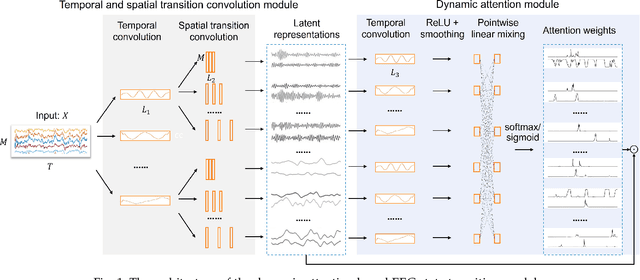
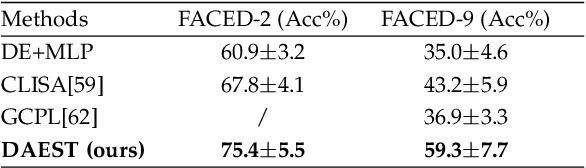
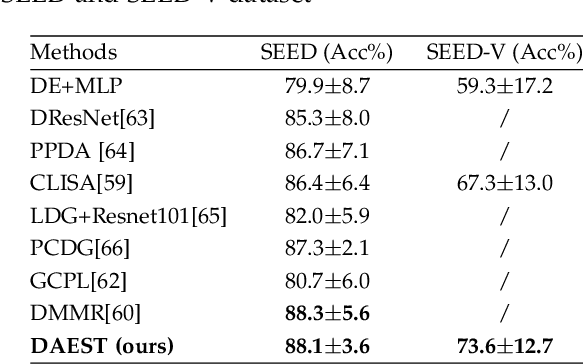
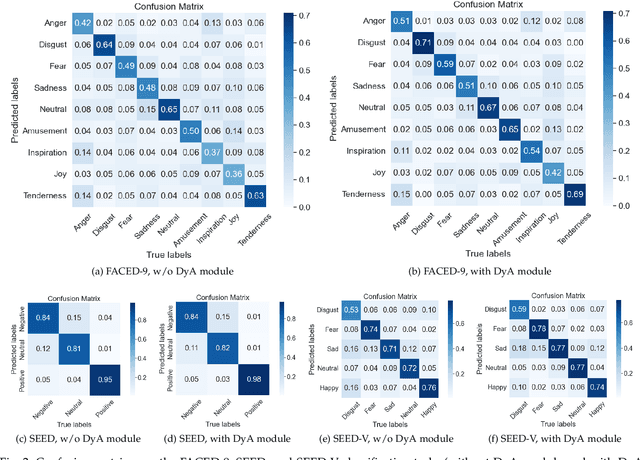
Electroencephalogram (EEG)-based emotion decoding can objectively quantify people's emotional state and has broad application prospects in human-computer interaction and early detection of emotional disorders. Recently emerging deep learning architectures have significantly improved the performance of EEG emotion decoding. However, existing methods still fall short of fully capturing the complex spatiotemporal dynamics of neural signals, which are crucial for representing emotion processing. This study proposes a Dynamic-Attention-based EEG State Transition (DAEST) modeling method to characterize EEG spatiotemporal dynamics. The model extracts spatiotemporal components of EEG that represent multiple parallel neural processes and estimates dynamic attention weights on these components to capture transitions in brain states. The model is optimized within a contrastive learning framework for cross-subject emotion recognition. The proposed method achieved state-of-the-art performance on three publicly available datasets: FACED, SEED, and SEED-V. It achieved 75.4% accuracy in the binary classification of positive and negative emotions and 59.3% in nine-class discrete emotion classification on the FACED dataset, 88.1% in the three-class classification of positive, negative, and neutral emotions on the SEED dataset, and 73.6% in five-class discrete emotion classification on the SEED-V dataset. The learned EEG spatiotemporal patterns and dynamic transition properties offer valuable insights into neural dynamics underlying emotion processing.
RMAFF-PSN: A Residual Multi-Scale Attention Feature Fusion Photometric Stereo Network
Apr 14, 2024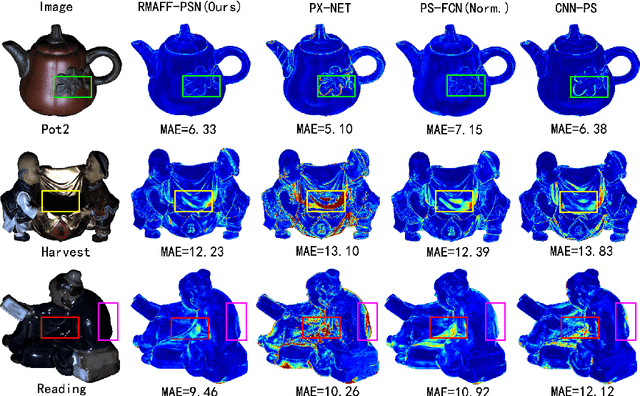
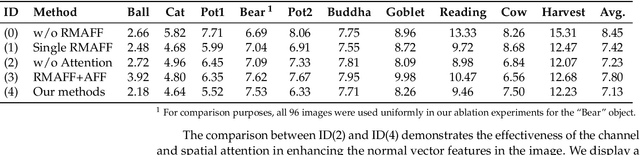
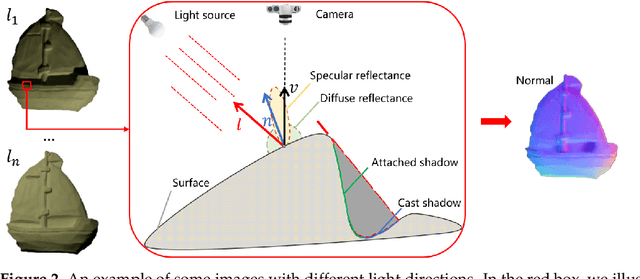
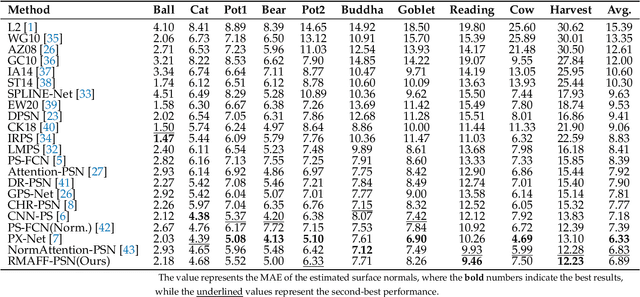
Predicting accurate normal maps of objects from two-dimensional images in regions of complex structure and spatial material variations is challenging using photometric stereo methods due to the influence of surface reflection properties caused by variations in object geometry and surface materials. To address this issue, we propose a photometric stereo network called a RMAFF-PSN that uses residual multiscale attentional feature fusion to handle the ``difficult'' regions of the object. Unlike previous approaches that only use stacked convolutional layers to extract deep features from the input image, our method integrates feature information from different resolution stages and scales of the image. This approach preserves more physical information, such as texture and geometry of the object in complex regions, through shallow-deep stage feature extraction, double branching enhancement, and attention optimization. To test the network structure under real-world conditions, we propose a new real dataset called Simple PS data, which contains multiple objects with varying structures and materials. Experimental results on a publicly available benchmark dataset demonstrate that our method outperforms most existing calibrated photometric stereo methods for the same number of input images, especially in the case of highly non-convex object structures. Our method also obtains good results under sparse lighting conditions.
* 17 pages,12 figures